Why Regular Stretching Helps Young Athletes—and Why More Is Not Always Better
Approximate reading time: 7–8 minutes
Flexibility is often one of the first qualities people associate with acrobatics, aerial arts, gymnastics and dance. It can make movements feel more comfortable, allow athletes to achieve particular shapes and support the technical requirements of their sport.
However, stretching is also one of the most misunderstood parts of youth training.
Does stretching prevent every injury? No. Should stretching hurt? No. Is holding a long stretch immediately before jumping, tumbling or performing explosive skills always helpful? Not necessarily.
Regular stretching can help improve or maintain a joint’s range of motion, but it should be approached in the same way as any other form of training: gradually, consistently and with consideration for the individual athlete.
For young athletes, the aim should not be to become as flexible as possible. The aim is to develop the useful, controlled mobility needed to participate safely and confidently.
Flexibility and mobility are related—but not identical
Flexibility generally refers to how far a muscle and surrounding tissues can lengthen. Mobility is a broader term describing how well a joint can move through a range of motion with control.
An athlete may be flexible enough to place their leg into a particular position but lack the strength to lift, hold or control it there. Another athlete may have adequate flexibility but use poor technique when moving through that range.
This is why flexibility should not be developed in isolation. Young athletes also need strength, coordination, body awareness and control.
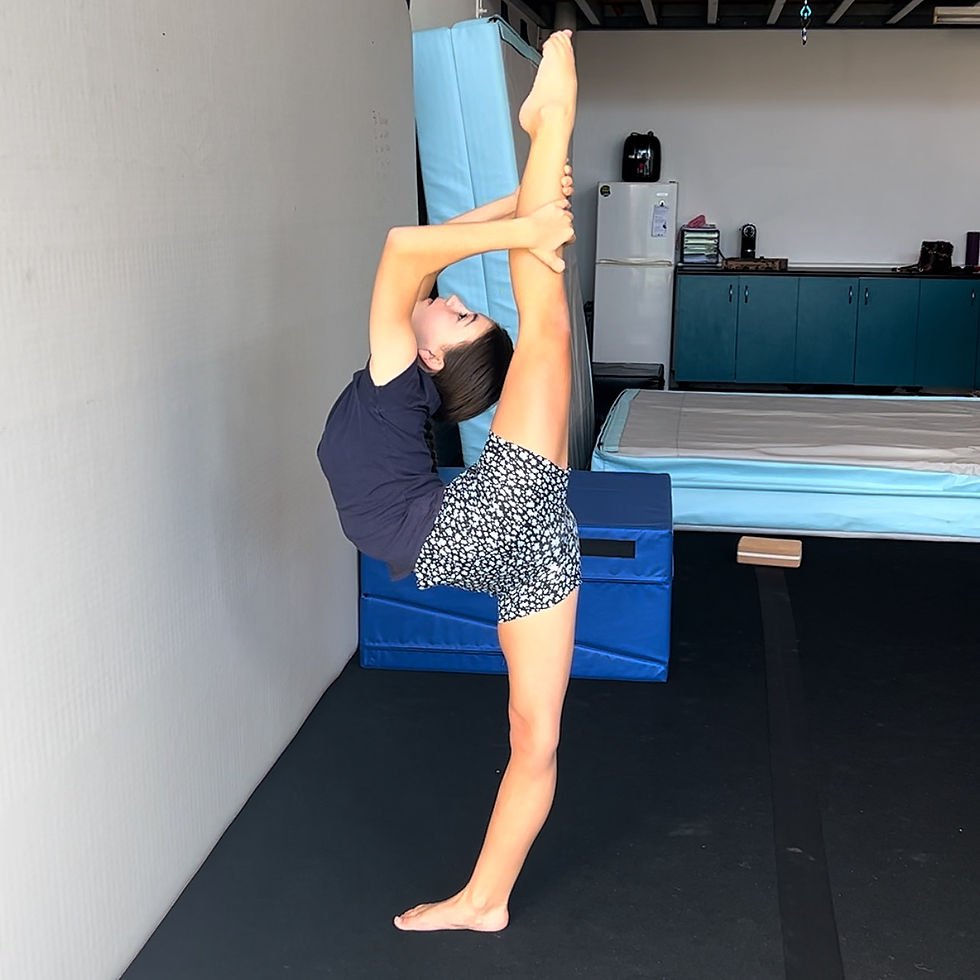
In an artistic sport, an athlete may need enough range to achieve a split position, bridge, kick or overhead shoulder shape. However, the skill also requires them to enter the position safely, maintain alignment and return from it with control.
Passive flexibility without active control does not automatically improve performance.
What happens when we stretch?
A static stretch involves moving a joint towards the end of its available range and holding the position. Dynamic stretching uses controlled movement through a range rather than maintaining one position.
When a person begins stretching regularly, early improvements in range of motion may partly occur because they become more comfortable with the sensation of stretching. Over time, changes may also occur in the mechanical behaviour of the muscle–tendon unit.
This does not mean the muscle permanently becomes “long” after one session. Flexibility develops through repeated exposure, just as strength and coordination develop through repeated training.
A 2023 systematic review examining static stretching intensity found that static stretching can improve range of motion. Importantly, the evidence did not support the idea that stretching must be extremely intense to work. Lower-intensity stretching may produce useful improvements while being more comfortable and easier to perform consistently.
That matters for children. Painful stretching is not a sign that a session is more effective.
Why regular practice can help
A single stretching session may temporarily increase how far an athlete can move. Longer-term improvements generally require stretching to be repeated over time.
Regular practice gives the athlete repeated, manageable exposure to the positions required in their activity. This can improve familiarity, tolerance and movement confidence.
For many athletes, a short and well-planned routine completed regularly is more useful than one very intense session performed occasionally.
Regular stretching may help an athlete:
Improve or maintain range of motion.
Become more comfortable in required positions.
Reduce feelings of stiffness.
Develop awareness of left-to-right differences.
Practise breathing and relaxation.
Support technical positions required in their activity.
Build a consistent movement routine.
However, “every day” should not mean completing intense flexibility training every day.
Some days may involve a short mobility sequence. Other days may include a more structured flexibility session. After a demanding training session, an athlete may need recovery rather than additional high-intensity stretching.
The appropriate frequency and intensity depend on the athlete’s age, training history, current range, goals and total training load.
Does stretching prevent injuries?
Stretching is often presented as an injury-prevention solution, but the evidence is more complicated.
No single exercise can prevent every injury. Injury risk is influenced by many factors, including training load, fatigue, strength, technique, recovery, previous injury, growth, equipment and the demands of the activity.
Stretching may be useful when an athlete genuinely lacks the range of motion required for a movement. If a joint cannot comfortably access a necessary position, the athlete may compensate elsewhere in the body.
However, improving range of motion does not automatically remove injury risk. An athlete must also have the strength and coordination to control that range.
Stretching should therefore form one part of a broader physical preparation program that includes:
Progressive strength training.
Skill development.
Appropriate warm-ups.
Load management.
Adequate sleep and recovery.
Good technique.
Early responses to pain or persistent discomfort.
It is more accurate to say that stretching can support physical preparation than to promise that stretching alone will prevent injuries.
Does stretching reduce muscle soreness?
Many athletes stretch after training because they believe it will prevent next-day muscle soreness.
Stretching may feel calming or provide temporary relief from stiffness, but research does not show that post-exercise stretching reliably prevents delayed-onset muscle soreness.
This does not make a gentle cool-down pointless. Athletes may enjoy using light movement, breathing and comfortable stretches to transition out of training. The problem arises when stretching is presented as a guaranteed way to remove soreness or speed recovery.
Recovery still depends on factors such as sleep, nutrition, hydration, rest and the athlete’s overall training load.
Static or dynamic: which should an athlete use?
Both forms of stretching can be useful, but they serve different purposes.
Dynamic stretching
Dynamic stretching involves controlled movements through an available range.
Examples include:
Controlled leg swings.
Arm circles.
Walking lunges.
Gentle torso rotations.
Repeated ankle movements.
Sport-specific movement patterns.
Dynamic movements are often useful during a warm-up because they increase movement, temperature and readiness without requiring the athlete to remain still for long periods.
A good warm-up should gradually prepare the athlete for what they are about to do. If the session includes jumping, turning, climbing or supporting body weight, the warm-up should progressively introduce similar movement demands.
Static stretching
Static stretching involves moving into a position and holding it.
It may be used:
As part of a separate flexibility session.
After the body has been appropriately warmed.
During technical work that requires a particular range.
At the end of training when intense explosive work is finished.
As part of an individual program prescribed by a qualified professional.
Long static stretches immediately before activities requiring maximum strength, speed or power may temporarily reduce performance—particularly when stretches are intense, sustained for longer periods and not followed by an active warm-up.
A major research review found that static stretching lasting less than 60 seconds per muscle group generally produced only small average changes in immediate performance, while longer durations were associated with larger reductions.
This does not mean athletes must avoid static stretching before every session. It means the dose, purpose and placement of stretching matter.
For an artistic athlete who requires a large range of motion, some static flexibility preparation may be relevant. It should be followed by active movements that help the athlete control the range and prepare for the skills ahead.
What should daily stretching look like?
A daily routine does not need to be long or extreme.
For many young athletes, an appropriate routine could involve several minutes of comfortable mobility and controlled movement. The exact exercises should reflect the athlete’s needs and should be approved by an appropriately qualified coach or health professional.
A sensible routine should:
Begin when the body is warm.
Use controlled positions.
Target ranges relevant to the athlete.
Include both sides of the body.
Remain within a tolerable stretch sensation.
Include active control or strengthening where appropriate.
Avoid bouncing or forcing.
Stop if the athlete experiences pain, tingling, numbness or joint instability.
Children should not copy an advanced athlete’s stretching program simply because they want the same skills. The advanced athlete may have years of preparation, different anatomy and professional supervision.
Stretching should create tension—not pain
A stretch may produce a pulling or lengthening sensation. It should not cause sharp, burning, pinching or electrical pain.
Pain is not evidence that the stretch is “working”.
An athlete should stop and tell a coach, parent or guardian if they experience:
Sharp or sudden pain.
Pinching inside a joint.
Tingling or numbness.
A feeling that the joint may give way.
Pain that continues after stretching.
Swelling or bruising.
A sudden loss of movement.
Persistent pain affecting training or everyday activities.
Coaches should never force a child into a deeper position by pushing on their body. They should also avoid encouraging athletes to compete over who can stretch the furthest.
If pain is persistent, worsening or connected to an injury, the athlete should be assessed by an appropriately qualified health professional.
Growth can temporarily change flexibility and coordination
Children’s bodies do not grow at a perfectly even rate. During periods of rapid growth, an athlete may temporarily feel tighter, less coordinated or less comfortable in positions they previously managed.
This does not mean they have become lazy or stopped trying.
Bones, muscles, tendons and the nervous system are adapting to changing body proportions. The athlete may need modified expectations, additional strength work or a temporary reduction in stretching intensity.
Comparing young athletes can be particularly unhelpful during these periods. Two athletes of the same age may be at very different stages of physical development.
Progress should be assessed against the individual athlete—not against the most flexible person in the group.
Flexibility is partly individual
An athlete’s range of motion is influenced by training, but it is also affected by anatomy, joint structure, age, previous injury and other individual factors.
Not every athlete will achieve exactly the same shape, and not every body should be pushed towards the same end range.
Some athletes naturally have greater joint mobility. These athletes may not need more passive flexibility; they may benefit more from building strength and stability through the range they already possess.
This is another reason stretching programs should not rely on a one-size-fits-all approach.
Consistency matters more than intensity
The best flexibility program is not the one that creates the most discomfort. It is the one that is appropriate, repeatable and connected to the athlete’s actual needs.
Gentle daily mobility can help an athlete become familiar with useful ranges of motion. More demanding flexibility work should be planned carefully around training, recovery and growth.
For young artistic athletes, flexibility is only one part of the picture. A beautiful position must also be supported by strength, control, coordination and safe technique.
The goal is not simply to move further.
The goal is to move well.
About Neophyte Performance
At Neophyte Performance, flexibility and mobility are introduced progressively as part of broader athlete development.
We aim to help athletes build the range of motion needed for their activities while also developing the strength, control and body awareness required to use that range safely.
Athletes are encouraged to communicate when a position feels uncomfortable or painful. Stretching should challenge an athlete appropriately, but it should never rely on force, comparison or pressure.
References and further reading
Bryant J, Cooper DJ, Peters DM, Cook MD — The effects of static stretching intensity on range of motion: a systematic review
Behm DG and colleagues — Acute effects of muscle stretching on physical performance, range of motion and injury incidence: a systematic review
Australian Government Department of Health, Disability and Ageing — Physical activity recommendations for children and young people
Exercise & Sports Science Australia — Find an Accredited Exercise Physiologist


Comments